In modern industrial production, especially in industries such as building materials, chemicals, metallurgy, food, and energy, precise material proportioning is crucial for ensuring product quality, optimizing resource utilization, and enhancing economic efficiency. The belt scale DCS (Distributed Control System) automatic batching control system, as the core technical solution for this process, has become an ideal choice for achieving continuous, stable, and efficient batching due to its high degree of automation, precise control capabilities, and powerful data processing and analysis functions.
Traditional batching methods rely on manual operations and standalone instruments, which suffer from low accuracy, poor stability, scattered data, and difficulties in real-time monitoring and adjustment. With the advancement of industrial automation and the maturation of DCS technology, the belt scale DCS automatic batching control system emerged.
It integrates multiple belt scales and feeding devices onto a unified distributed control platform, enabling full-process intelligence and automation from material measurement, proportioning calculation, equipment control, to data management, significantly improving the accuracy, efficiency, and reliability of the batching process.
Main Functions and Characteristics of the Belt Scale DCS Automatic Batching Control System
1. Data Acquisition and Control Functions of the Batching System
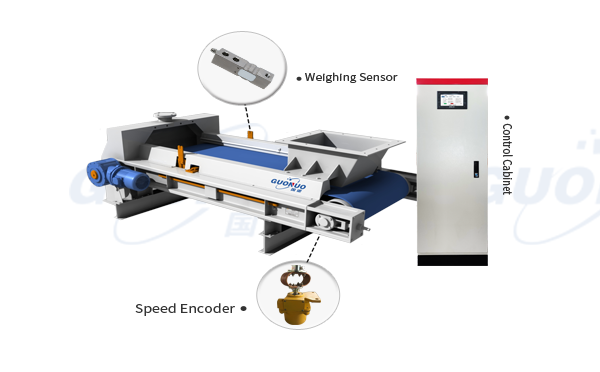
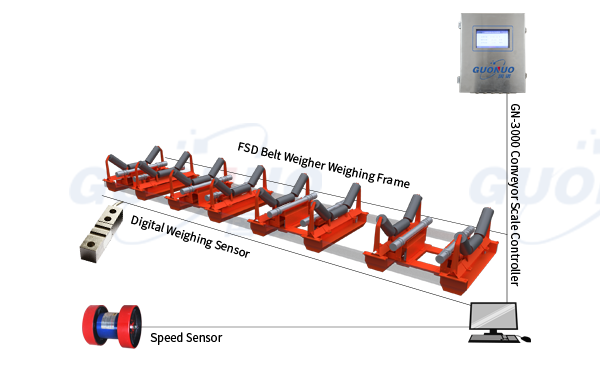
- High-precision real-time data acquisition: The system continuously collects weight signals, speed signals, and operational status signals (running/stopped/fault) from belt scales, as well as other auxiliary signals (such as silo level, temperature, etc.). Advanced signal processing techniques (such as filtering, amplification, analog-to-digital conversion) and compensation algorithms (such as belt tension, misalignment, zero/span drift compensation) ensure high accuracy and stability of the measurement data.
- Intelligent closed-loop control: This is the "brain" of the system. The DCS controller calculates the actual flow rate of each material in real-time, compares it with the target flow rate set in the recipe, and employs PID (Proportional-Integral-Derivative) or more advanced adaptive control algorithms to dynamically adjust the speed of the feeding equipment, forming a precise closed-loop control loop. The system features start/stop sequence control and interlock protection (such as blockage, material breakage, and over-limit alarm and shutdown) to ensure a safe and smooth process.
- Multi-material proportioning management: Supports complex recipe management, allowing for the storage and recall of multiple production recipes. It flexibly sets parameters such as target flow rate, proportioning percentage, and batch total for each material. The system automatically calculates and coordinates the control of multiple batching lines to achieve precise synchronous proportioning of multiple materials.
2. Data and Historical Record Analysis
- Comprehensive data recording: The system automatically and continuously records all key process data, including instantaneous flow rate, cumulative amount, set value, control output (such as frequency converter frequency), equipment status, and alarm information for each belt scale, with precise timestamps.
- Massive historical storage: Utilizing the powerful historical database function of the DCS, process data is stored long-term and securely on high-performance servers, supporting rapid retrieval and query.
- In-depth data analysis and reporting: Provides rich data analysis reports, such as flow rate variation curves, which display production process fluctuations; shift reports/daily reports/monthly reports, which are key performance indicators for analyzing production efficiency and energy consumption.
3. Graphical Interface
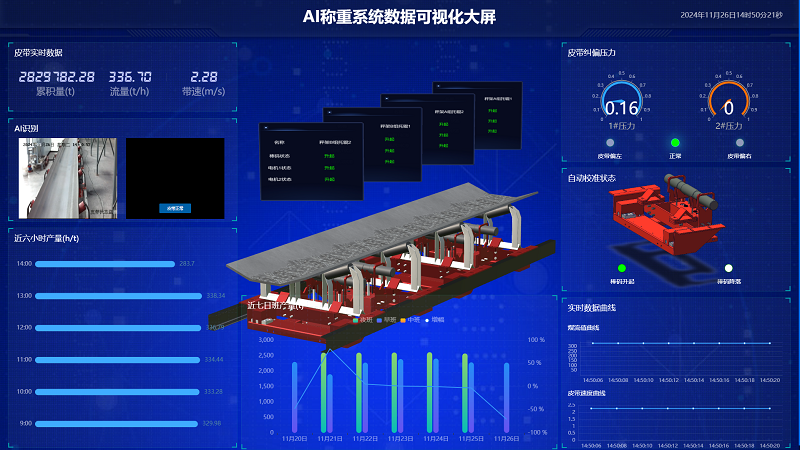
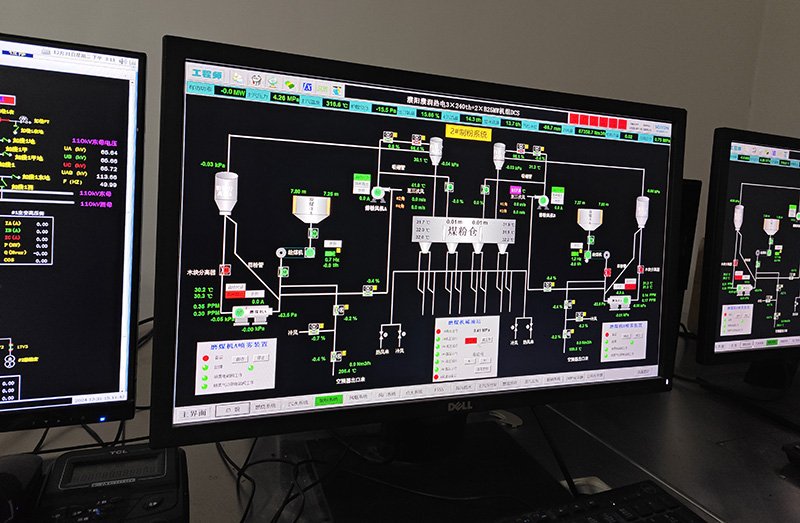
- Centralized monitoring: Through a high-resolution display with a graphical interface, operators can monitor the overall status of the entire batching system at a glance, including the operational status (running/stopped/fault), real-time flow rate, cumulative amount, set value, proportioning deviation, and equipment parameters of each batching line.
- Process visualization: Dynamically displays the material flow, equipment location, valve switch status, and silo level in the form of a dynamic process flow diagram, making complex processes clear and understandable.
- Convenient operation: Provides a user-friendly operation panel for operators to select recipes, set parameters, start/stop equipment, switch between manual/automatic modes, and fine-tune set values.
- Hierarchical permission management: Sets operation permissions based on different roles (operator, administrator) to ensure system security and operational compliance.
4. Alarm Control and Management
- Real-time alarm monitoring: The system continuously scans all monitoring points for preset abnormal conditions (such as flow rate exceeding limits/being too low, significant proportioning deviations, belt scale faults, speed abnormalities, silo level exceeding limits, equipment faults, communication interruptions, etc.).
- Alarm recording and handling: All alarm information is recorded in detail (occurrence time, point, description, confirmation time/personnel, recovery time), forming an alarm history log. Operators are required to promptly confirm alarms, and the system can provide preliminary fault diagnosis suggestions or interlock actions (such as automatic shutdown of material feeding).
The belt scale DCS automatic batching control system is a core piece of equipment for refined industrial production in modern times. It integrates high-precision measurement technology, powerful distributed control capabilities, real-time data acquisition, in-depth historical data analysis, intuitive graphical monitoring interfaces, and comprehensive alarm management mechanisms. Its core value lies in improving accuracy and stability, enhancing production efficiency, reducing production costs, strengthening process control, and ensuring safe operation.