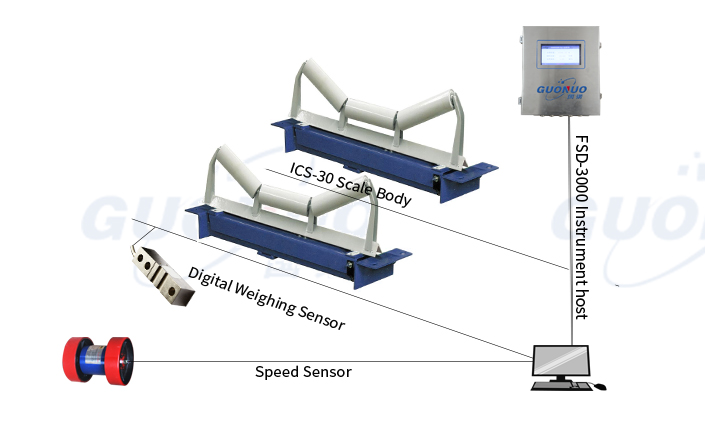
In industries such as ports, building materials, mining, power, metallurgy, etc., large quantities of bulk materials need to be transported in daily life. Electronic belt scales play a dynamic weighing and measuring role, which can complete weighing without interrupting material transportation and provide users with weight data of materials, facilitating production control, trade settlement, etc.
However, in practical applications, the measurement accuracy of electronic belt scales is inevitably affected by factors such as belt tension, conveyor conditions, and environment. In order to improve the comprehensive performance of electronic belt scales, such as accuracy, stability, and environmental adaptability, and to maximize their value and role in production activities, belt scale manufacturers have developed and designed a new matrix electronic belt scale, which breaks through the bottleneck of traditional belt scales and has incomparable advantages and characteristics.
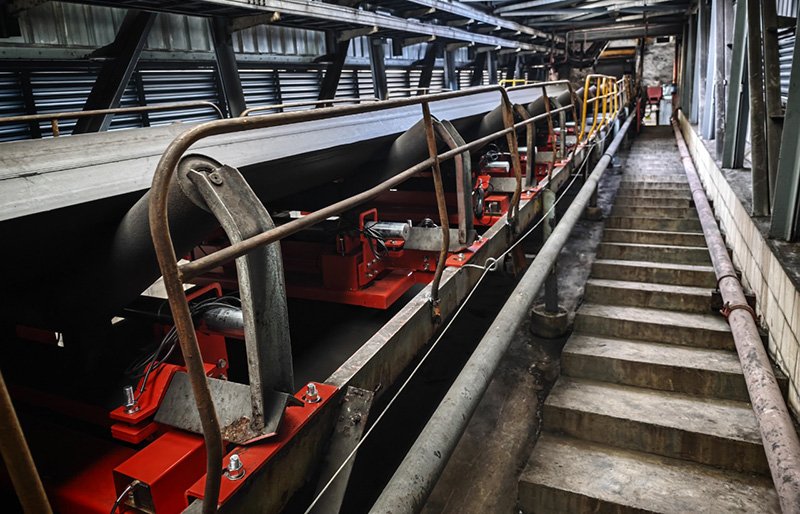
The main problems with traditional electronic belt scales are:
(1) Low measurement accuracy: Traditional electronic belt scales have complex structures and are affected by mechanical components, friction, and force transmission losses during the measurement process. The measurement accuracy is not high, generally reaching 0.5 level is already good, and the accuracy level is basically above 1.0.
(2) High manufacturing and transportation costs: Traditional electronic belt scales require the deflection of the weighing frame to be less than 0.5mm at maximum flow rate, the radial runout of the rollers to be less than 0.2mm, and the axial displacement to be less than 0.5mm in order to achieve high accuracy. The weighing frame is large, complex, and structurally bulky, resulting in higher manufacturing and transportation costs.
(3) Poor adaptability to the environment: The requirements for the on-site belt conveyor and environmental conditions are high, and there are strict regulations on the inclination angle of the belt conveyor, the deflection of the longitudinal beam of the belt scale and conveyor, the unloading device, and the number of dropping points.
(4) Difficulty in installation and adjustment: Due to the bulky body of traditional electronic belt scales, it is difficult to install them. If adjustments are needed later, it will be difficult, with poor flexibility and high labor intensity.
(5) Poor stability: easily affected by factors such as environment and belt tension, traditional electronic belt scales have poor long-term ability to maintain measurement accuracy.
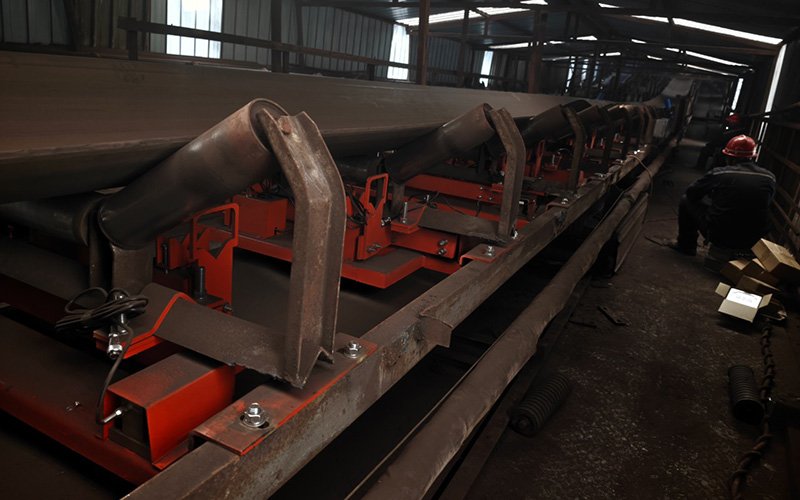
In response to the problems of traditional electronic belt scales, Guonuo Technology has designed and manufactured a matrix electronic belt scale using new concepts and technologies, which integrates high precision, intelligence, stability, self calibration, and strong adaptability.
The advantages of matrix electronic belt scales:
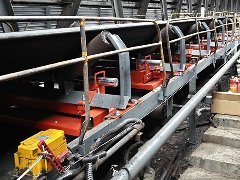
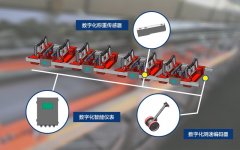
(1) Advanced design concept: Adopting a multi group scale frame combination structure, each weighing roller is equipped with multiple weighing sensors to form a weighing unit. The units all use a fully suspended structure, which is simple in structure, frictionless, unable to transmit losses, and has no support points; Simple structure, easy installation and adjustment; The combination scale frame can be flexibly combined and adjusted according to the actual situation, extending the weighing area;
(2) Automatic verification technology: With real-time "online verification" function, self verification can be carried out at any time according to the situation to maintain measurement accuracy;
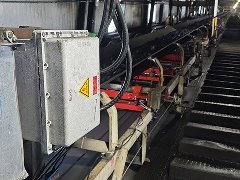
(3) High precision digital weighing sensor: using an analog converter to convert analog signals into digital signals, with strong anti-interference ability, ensuring accurate and stable weighing signals, thereby improving measurement accuracy;
(4) Low maintenance and repair costs: simple structure, small horizontal surface, excellent long-term stability, basically eliminating daily cleaning and maintenance work, saving time and effort;
(5) Strong adaptability: Suitable for conveyors with different bandwidths, flow rates, roller spacing, and climbing curves.