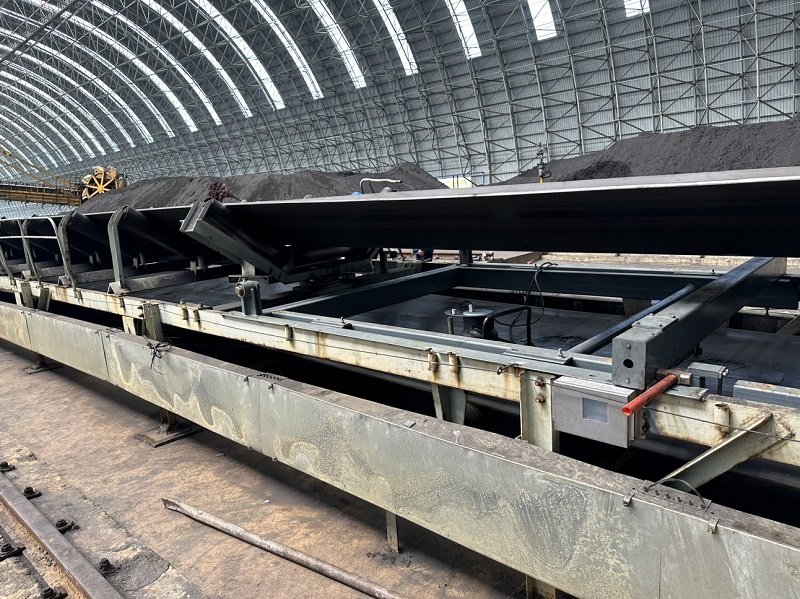
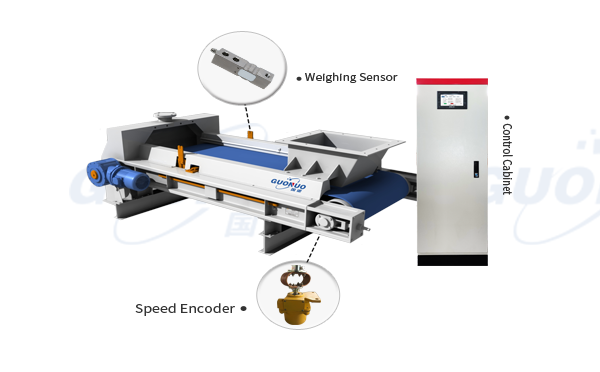
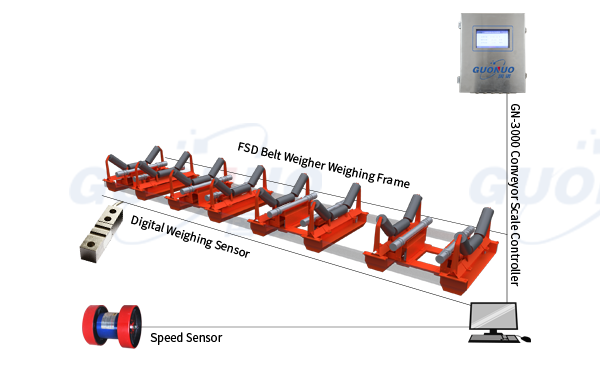
The core innovation lies in the complete elimination of traditional lever structures. Within the designated weighing zone, numerous independent high-precision weighing sensors are densely arranged longitudinally along material conveying direction and transversely across belt width. Integrated underneath customized weighing rollers or roller sets, these sensors form a distributed measuring matrix.
This distributed architecture delivers groundbreaking superiorities:
1.Global Perception via Multi-Point Detection
Each sensor independently detects instantaneous material weight in its corresponding tiny area. The powerful data processing unit collects and integrates all sensor signals in real time without mechanical simplification of levers. It accurately captures actual material distribution in both horizontal and vertical directions, boosting overall measuring accuracy up to ±0.25% or higher.
2.Outstanding Anti-Interference Performance
Multi-point measurement features natural averaging and redundancy effects. Local anomalies of rollers, minor belt deviation, instantaneous material impact and uneven distribution only affect individual sensors, exerting negligible influence on total volume calculation and greatly improving measuring stability.
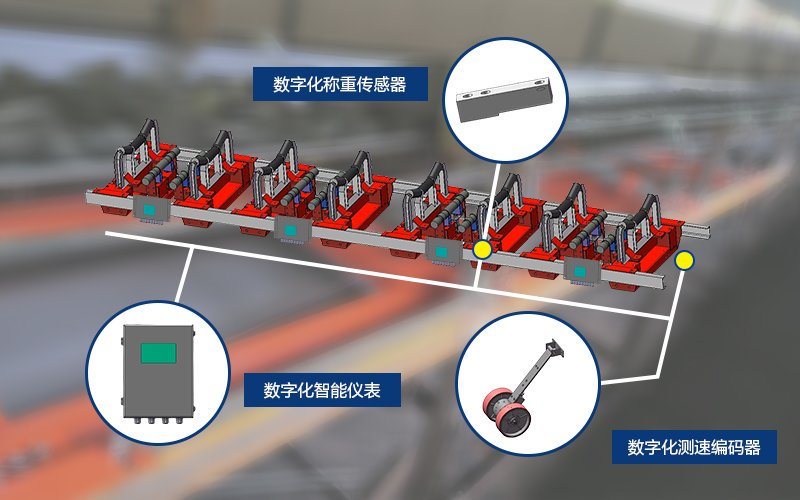
3.Insensitivity to Belt Tension Variation
Different from lever scales vulnerable to tension changes, matrix weighing units directly detect material pressure exerted on rollers, effectively isolating belt tension interference and securing authentic and dependable measuring results.
4.Relaxed Installation Standards
The multi-support structure imposes milder requirements on conveyor foundations and roller parallelism, facilitating convenient installation and commissioning, shortening construction periods and cutting operational costs.
5.Powerful Self-Diagnosis Function
The system monitors operating status and readings of each sensor in real time to rapidly locate faults such as stuck rollers and sensor malfunctions, facilitating routine maintenance and sustaining long-term stable precision.
Boasting superior performance, matrix electronic belt scales are widely applied in harsh and complex scenarios where conventional lever scales fail to meet accuracy demands. Typical applications cover trade measurement of bulk commodities like coal, ore and grain, uneven material conveying lines with inclination angles, old factory renovation projects, narrow spaces incompatible with long lever installation, as well as long-distance and large-capacity conveying routes.
Rather than a simple technical upgrade, the matrix electronic belt scale embodies revolutionary design concepts. Supported by distributed multi-point sensing and intelligent data fusion technology, it fundamentally eliminates inherent defects of lever structures and achieves substantial progress in measurement precision, stability, anti-interference capability and environmental adaptability.