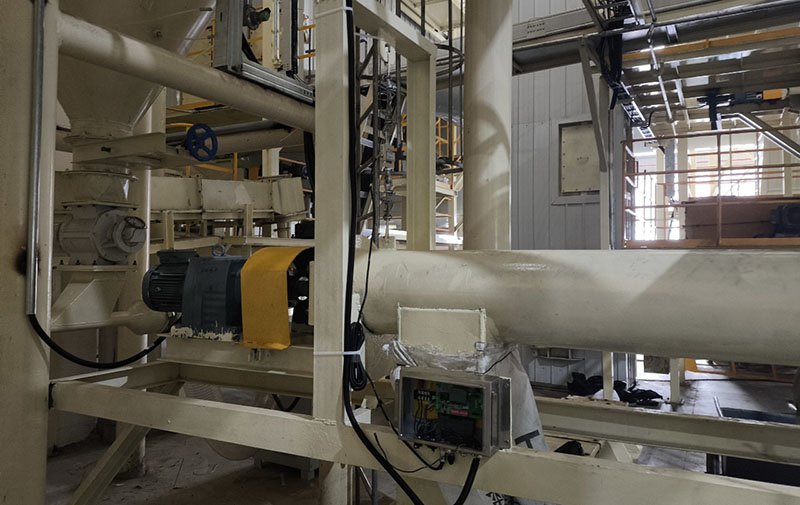
Spiral measuring scale is a production measuring and feeding equipment designed and developed on the basis of tubular screw conveyor, which applies electronic dynamic weighing and industrial automation control technology to transport, weigh, measure and quantitatively control powdered and granular materials. Spiral measuring scales have the advantages of simple structure, good system sealing, high degree of automation, stability and reliability, long service life, high cost-effectiveness, simple and convenient operation and maintenance, and strong adaptability. They are widely used in many industrial production sites.
In practical production applications, the structure of spiral measuring scales should be determined based on specific production processes, production capacity, material characteristics, and on-site working conditions.
1. Transportation capacity
The determination of the conveying capacity of the spiral measuring scale is based on different sizes of mixing tanks and feeding speeds. The conveying capacity of the spiral rod should be able to meet the maximum production capacity.
2. Import and export of materials
During the production process, it is possible to encounter the phenomenon of powdery or granular materials sticking together into blocks, which may block the inlet and outlet. If workers use tools to crush the materials during this process, it will cause additional load on the weighing sensor.
Therefore, the feed inlet should be enlarged as much as possible to prevent clumping materials from causing blockage and arching. The discharge port should be greater than the maximum feeding capacity of the screw conveyor to minimize the squeezing of materials behind it.
3. Spiral shaft
The method for determining the diameter of a spiral shaft is to minimize its stiffness, strength, and service life, in order to reduce the volume of the spiral scale and increase the effective conveying area.
The smaller the pitch of the spiral shaft, the smaller the error generated by the spiral measuring scale. However, if the pitch is too small, it may cause material conveying efficiency. The determination of the distance between spiral couplings should fully consider the particle size and characteristics of the material.
4. Spiral inlet and outlet length
The length of the spiral inlet and outlet should also consider the material characteristics. For materials with high friction and anti slip properties, the effective length of the spiral inlet and outlet should be designed as short as possible.
To prevent material accumulation and agglomeration on the inside of the feed inlet during the production process. For materials with high fluidity, in order to prevent material flushing and running, and to ensure uniform and constant material transportation, the effective length of the spiral inlet and outlet should be as long as possible.
5. Soft connection and cantilever spiral measuring scale fulcrum
To maintain a good measuring condition, the inlet and outlet parts of the spiral measuring scale must have good soft connection status. A conical structure with a small upper part and a large lower part can be used to reduce the time materials stay on the scale body, slow down the semi hardening and hardening time of the soft connection, and ensure long-term stability of the function.
At the same time, the fulcrum of the cantilever spiral measuring scale should be selected as much as possible in the middle position of the feeding port to reduce the adverse effects caused by material feeding deviation.
In addition to the conventional components, the structure determination of the spiral measuring scale should fully consider the actual production application situation, especially the production capacity, material characteristics, and application space, in order to ensure the adaptability of the equipment.